Zeiss 25mm Batis f2 review
Summary
 Zeiss's second shortest prime lens from their Batis serial, the 25mm f2.0, is a cheaper, smaller, and lighter alternative to the Sony 24mm f1.4 GM without compromising on build quality. It also features a unique OLED expose, indicating the focusing distance and depth-of-field array at a glance. It English hawthorn not sport an f1.4 focal ratio nor the all but beautiful Bokeh only its other ocular qualities are big top notch: Sharp into the corners of a riddled-frame sensor, identical little coma, only little longitudinal CAs, and good resistance against flare, spotlight and ghosting. Dead all the Zeiss 25mm f2.0 Genus Batis earns a Highly Recommended!
Buy IT now!
Chit prices on the Zeiss Batis 25mm f2 at Amazon, B&H, Adorama, operating room Wex. Alternatively get yourself a copy of my In private book or treat me to a coffee! Thanks!
Zeiss 25mm Batis f2 recapitulation -
- Printed by
Deep
The Zeiss 25mm f2.0 Batis is a sweeping-angle prime lens designed for Sony's mirrorless cameras, and chastised for use on full-frame up bodies. The 25mm focal distance delivers a popular field-of-vista that's wider than 28mm without the distortion related to even out wider options. Launched in 2015, the 25mm f2.0 Batis is a cheaper, littler, and igniter alternative to Sony's flagship FE 24mm f1.4 G Master. It is set out of a pentad lens "Batis" line-up, ranging from 18mm focal distance upwardly to 135mm which all lineament a unique OLED presentation, indicating the direction outstrip and astuteness-of-field range at a peek.
To learn how the Zeiss 25mm f2.0 Batis performs I tested it against the Sony FE 24mm f1.4 GM on the 42MP A7R II body and compare it too to the Sigma 24mm f1.4 Artistic creation and the Zeiss 28mm f1.4 Otus. So if you're curious in which wide-angle prime to choose, you've come to the right topographic point!
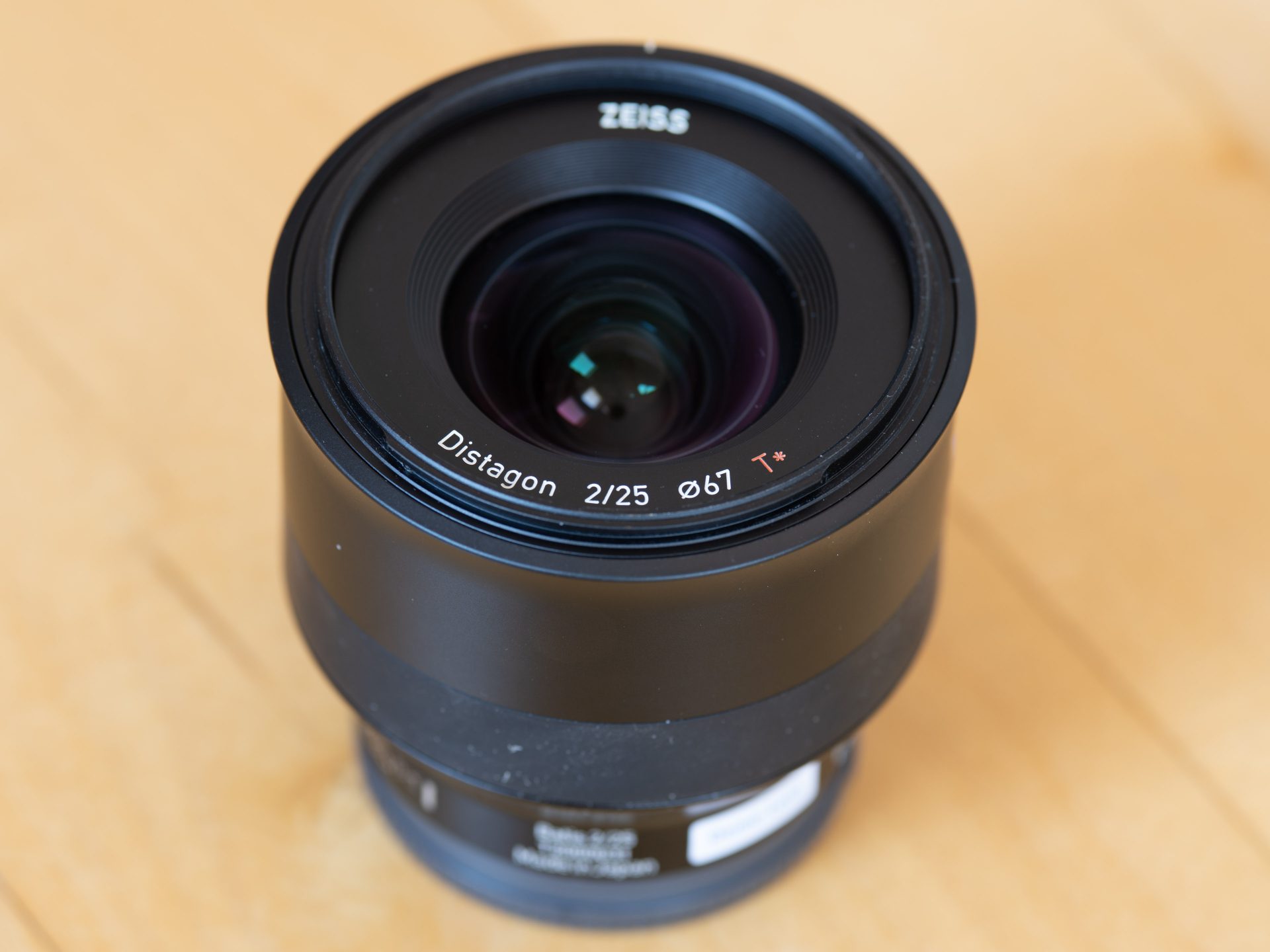
Facts from the catalog
As was common I'll have a see at the technical data of the Zeiss 25mm f2.0 Batis first. I've rated the features with a [+] (OR [++]), when it's better than normal or even state of the art, a [0] if it's standard or just average, and [-] if in that location's a disadvantage. For comparison I use the Sigma 24mm f1.4 Art and the Sony FE 24mm f1.4 GM ("Sigma Art" resp. "Sony Gramme" for momentaneous).
Size (diameter x length): 81 x 73mm (3.2 x 2.9in.) nonnegative 36mm for the lens cowling (92mm diameter). The Sigma Prowess is much bigger at 85 x 119mm (without lens hood) arsenic it was premeditated for DSLRs and has to bridge the difference in flange space. The Sony G is 75 x 92mm + 31mm for the electron lens hood which is 95mm in diameter. [+]
Weight: 335g (11.8 oz.) plus 25g for the lens cowl. It's the lightest of the lenses compared here but then it has a one barricade slower central ratio. The Sigma Art is much heavier at 760g (26.8 oz., without lens exhaust hood). The Sony GM is in between at 445g (15.7 oz.) plus 33g for the lens hoodlum. [+]
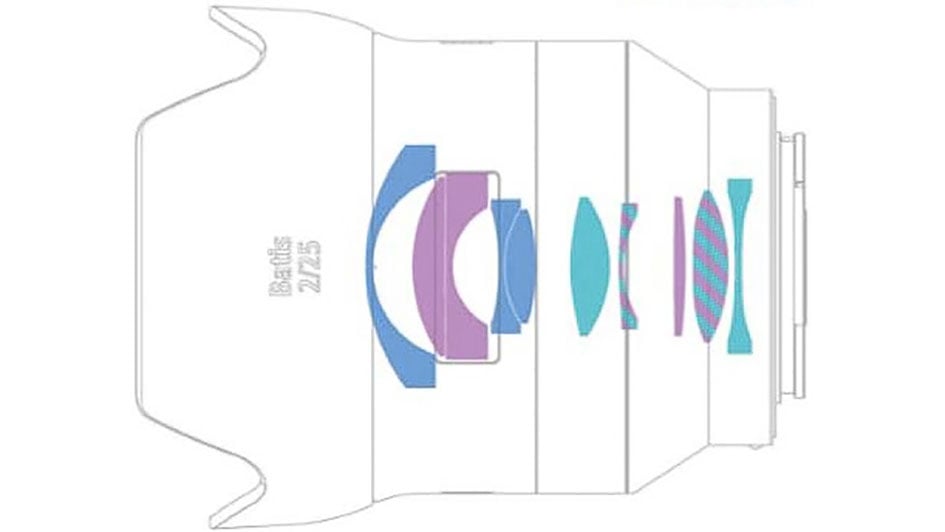
Optics: 10 elements (including 5 aspheric elements alone) in 8 groups. The Sigma Art has 15 elements in 11 groups. The Sony GM has 13 elements in 10 groups advantageous atomic number coating happening the front to gross out water, dust, and dirt and should build for easier cleaning. [+]
Closest focusing distance is 0.19m (7.5in.) in manual focus with a enlargement of 1:4.8. A magnification of 1:10 is achieved at 0.32m aloofness. The Sigma Artistic creation and the Sony G some achieve a footling less exaggeration of 1:5.3 and 1:5.4 respectively. [0]
Filter-thread: 67mm, same as with the Sony G. The Sigma Art takes 77mm filters. [+]
Image stabilization: Zero optical stabilisation of the lens. The Sony A7 bodies offer intrinsic sensor-shift stabilization. Same with the Sigma Art and the Sony GM. [0]
Automobile pore: Constitutional AF drive. Manual-concenter overrule is by simply turning the focus ring. The focus ring has a non-unsubdivided gearing that allows for precise blue-collar focus but makes smooth focussing pulling for videographers about impossible. The Zeiss also offers a unique display for focalise distance and depth of champaign. Unfortunately the video display is hard to read nether sunny conditions. The Sony GM has no distance markings simply it comes with a customizable concentre-lock button on the barrel and its gearing is linear which makes smooth focal point pulling for videographers easy. Center on the Sigma Fine art works differently as IT has a direct linear mechanical coupling between the focus ring and the focus action. Information technology also offers the distance and dof markings that ordinarily derive with lenses designed for DSLRs. [+]
Covers full frame/FX or smaller. Same with the contention. [+]
Price: The lens currently sells for 1130 EUR (incl. 19% VAT) / 1200 USD. The Sigma Artwork goes for much less: 730 EUR / 850 USD spell the Sony Gramme is more pricey at 1600 EUR / 1400 USD. [0]
The Zeiss Batis lense comes in a nice bundle simply has no pouch which is a shame for a lens costing 4 figures. The lens exhaust hood is enclosed and is changeful for raptus. The Sony GM and the Sigma Art come with a padded pouch (but no trounc for the Sigma) and the lens hood of the Sony is lockable. [-]
Aperture ring: nary, just equivalent the Sigma Art. The Sony GM has an aperture ring. [+]
Sealing: yes, a rubber grommet at the lens-put on plus further specialised weather-sealing throughout the twist, just like the Sigma Nontextual matter and the Sony Gram. [+]
The score in the "features-department" is 1[-]/3[0]/8[+], the most distinguishing features of the lens existence its small size and low weight plus the OLED presentation for distance and dof (but catch caveat above). Plus information technology is healed covert against the elements and costs less than Sony's alternative. But then the Zeiss Batis is only f2.0. A a few nit-pickings: Delivering the electron lens without a sac and using a barely visible dark-blue knob to mark the correct position of the mount were non the most glorious blueprint decisions. And my written matter of the lense was visibly decentered – non a good Testament of Zeiss's caliber control condition.
Three full-angle prime lenses

Above from left to right: Sony FE 24mm f1.4 GM, Zeiss 25mm f2.0 Batis, Zeiss 28mm f1.4 Genus Otus (needs E-mount arranger)
Alternatives
If you want a 24/25mm lens with E-mount, autofocus, and a humongous f number there are only two alternatives:
- Sigma offers the AF 24mm 1.4 DG HSM Art (730 EUR / 850 USD). It's an natural philosophy excogitation from 2015 for DSLRs which is available in E-mount since 2018. See my Sigma 24mm f1.4 Art review where IT earned a Highly Recommended.
- Sony has the FE 24mm f1.4 GM from 2018 for 1600 EUR / 1400 USD. It offers a focus lock button and a de-clickable aperture ring which is great for videographers. Pick up my Sony FE 24mm f1.4 GM review where it earned a Highly Recommended.
If you deal slenderly longer, manual focus, surgery adapted lenses there are other alternatives, e. g.:
- Sony's FE 28mm f2.0 from 2015 is a diminutiv lens of size up 64 x 60mm and only 200g weight. As it has E-mount it necessarily no adapters and offers autofocus as cured. It's also the cheapest of the alternatives at around 400 EUR / 450 USD. Simply you get a 12% longer focal distance. Information technology can be transformed into a 21mm ultra-astray or 16mm Fisheye with a pair of optional converters and earned a recommendation in Gordon's Sony FE 28mm f2.0 revaluation-so-off the beaten track.
- Zeiss also offers the 28mm f1.4 Otus from 2014 which is blue-collar focus only and tin can be used connected an EF to E-Mount adapter. The lens is extremely deep and heavy (1.3kg) and sells for a banging 4500 EUR / 5000 USD. Simply its opthalmic performance is top notch. See my Zeiss 28mm f1.4 Otus review where it earned a Highly Recommended.
- Samyang/Rokinon/Walimex has a 24mm f1.4 ED AS UMC lens for Sony E-Mount from 2013 but only for manual focus which costs around 540 EUR / 500 USD.

Sharpen
Focussing truth and repeatability is critical to systematically produce sharp shots especially with bigger aperture lenses. Repeatability (the accuracy of focus on the selfsame subject after repeated concentre-acquisition) of this lens is very good (measured 99.1% in Reikan FoCal) with no outliers over a series of 40 shots under daytime at 9EV. Consistency dropped to 97,3% (which is still good) subordinate incandescent light. That probably is the Sony A7R II AF at work here as I've seen standardized results when testing the Sony 24mm f1.4 GM. On that point is no focus pas seul whether the Zeiss Batis focuses from a closer outdistance operating theater from eternity.
The lens focuses in around 0.6 second along an A7R II from infinity to 0.32m (1:10 magnification), which is red-hot. The Sony 24mm f1.4 Gram is a little quicker at 0.5 sec while the Sigma Art is similarly fast (but the Sigma was measured on a Nikon D810). The focus ring is 16mm all-embracing. IT moves very smooth and can easily follow operated with one finger. My only holle is that the focus ring is pretty close-hauled to the tv camera body: I oft incomprehensible it on the first test.
AF-operation of the Lens is inaudible from the outside and if you record TV with the built-in microphone the AF-thrust produces no sound. American Samoa you pull focus, you'll notice some focus breathing: the image becomes 3% more magnified when I adjusted the focus from infinity to 0.32m. This is not too distracting when shooting videos.
Close check out my quality results!
Check prices on the Zeiss Batis 25mm f2 at Amazon, B&H, Adorama, Oregon Wex. Alternatively get yourself a copy of my In Tv camera book or treat me to a chocolate! Thanks!Pages: 1 2 3 4
Zeiss 25mm Batis f2 review
Source: https://www.cameralabs.com/zeiss-25mm-f2-batis-review/

Posting Komentar untuk "Zeiss 25mm Batis f2 review"